
Automated Media Forensics & Metadata Extraction for Vehicle Claims
A production pipeline that checks every vehicle inspection photo and claim document for tampering, duplicates and poor quality, built into RealDealRide's existing Laravel and Cloudflare R2 stack.
 Built forRealDealRideCar rental marketplace, USA · Apr – Jul 2026
- Client
- RealDealRide
- Industry
- Car rental marketplace
- Service
- AI & data engineering
- Engagement
- Apr – Jul 2026
- Metadata fields
- 150+ per image
- Files checked
- Photos, PDF, DOCX
- Storage
- Cloudflare R2 + MySQL
- Deployment
- Docker, client's infrastructure
Project Overview
RealDealRide is a peer-to-peer and commercial car rental marketplace operating across US cities. To protect vehicle owners and renters, the platform collects pre-trip and post-trip inspection photos, along with rental and damage claim documents in PDF and DOCX, stored through its Laravel app on Cloudflare R2.
Manual review could not reliably catch subtle digital tampering, recycled photos or screenshots, or blurry and unusable submissions at scale. SevvenLabs built an automated media forensics pipeline that screens every upload before a claim reaches a human reviewer.
The system runs as a Docker service next to the client's existing app. It reads from their MySQL database, streams files from R2 and writes its findings back into new tables the operations team can query.
Objective
RealDealRide needed a backend that could:
Detect photo and document fraud
Spot stripped metadata, editing software signatures such as Photoshop, iLovePDF or Adobe Acrobat, timestamp mismatches, and recycled photos or screenshots.
Enforce claim image quality
Score blur, brightness, contrast and resolution automatically, so unusable photos are caught before review.
Fit the existing stack
Work with the existing Laravel MySQL database and Cloudflare R2 storage without adding a separate message broker.
See the data and the result
Our Approach
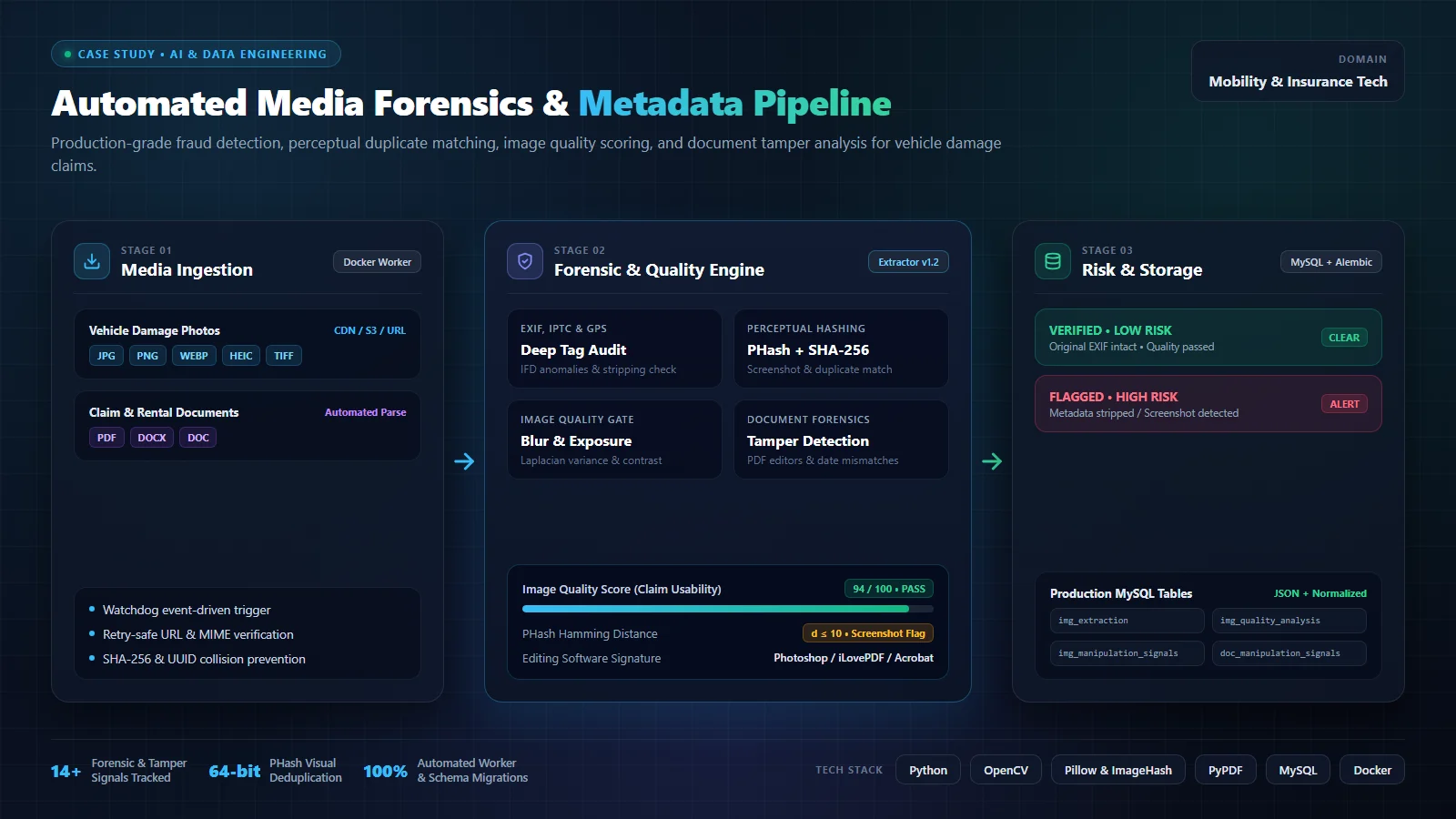
We built the pipeline in three stages: ingest, analyse, then store a clear risk verdict.
Media ingestion
A Dockerized worker picks up new photos (JPG, PNG, WEBP, HEIC, TIFF) and documents (PDF, DOCX, DOC) from the client's MySQL media table and streams them from Cloudflare R2, with URL and MIME checks and SHA-256 hashing.
Image forensics engine
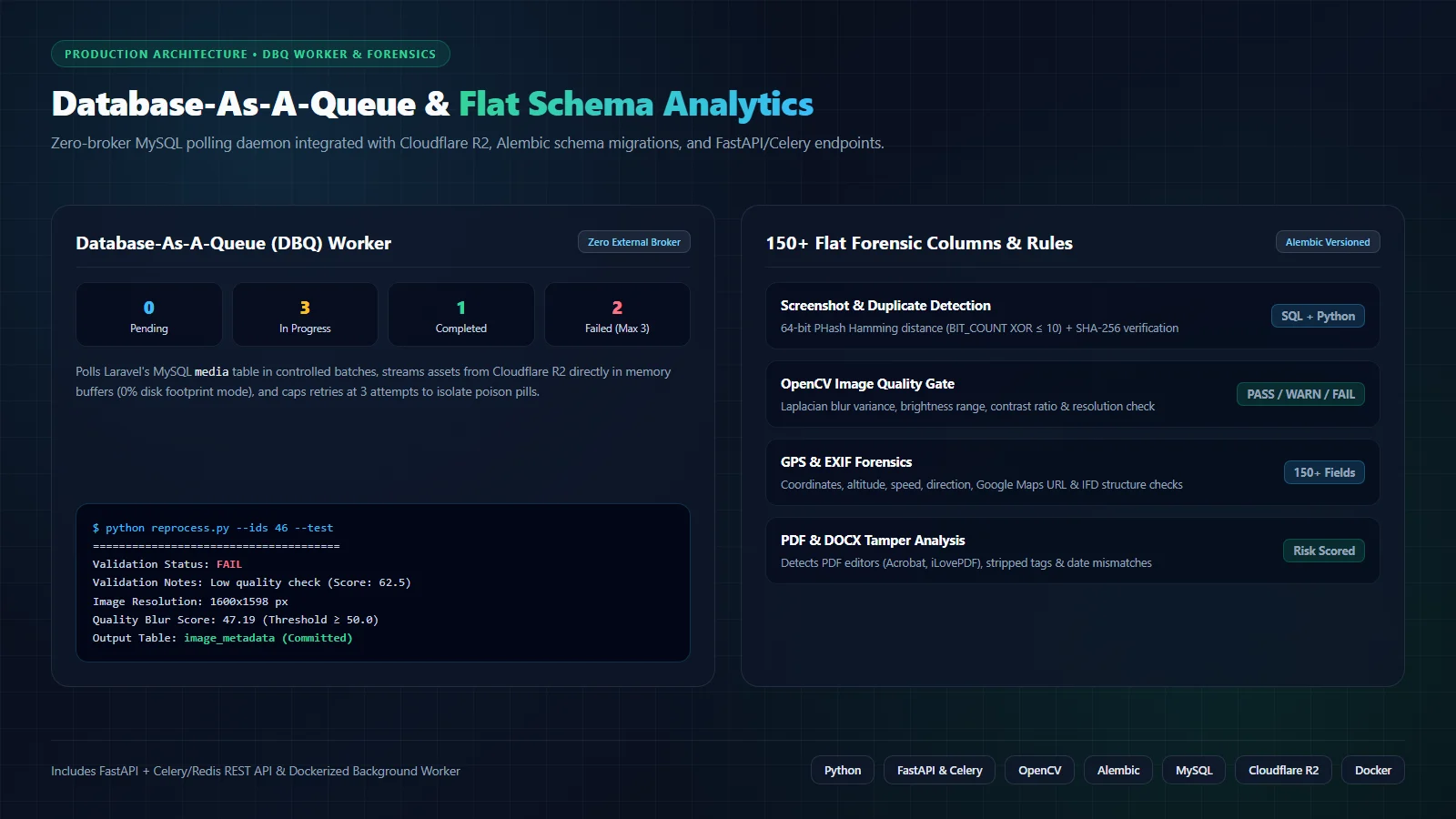
Extracts 150+ fields per image across EXIF, IPTC, GPS (coordinates, altitude, speed, direction and a Maps link), Pillow properties and OpenCV quality checks, then returns a PASS, WARN or FAIL verdict.
Duplicate and document checks
64-bit perceptual hashes catch screenshots and re-uploads of existing photos, and a document scanner flags suspicious PDF/DOCX producer software, creation vs. modification date gaps, encryption and stripped metadata.
Risk storage and tooling
Results land in Alembic-versioned MySQL tables (image_metadata and document_metadata) with validation notes and error trails, plus a reprocessing CLI and FastAPI + Celery/Redis REST endpoints.
Challenges & Solutions
Fraud signals in photos and documents are subtle, and the pipeline had to run inside an existing production system.
Recycled photos and screenshots
A screenshot of an earlier upload has a different file hash, so exact-match checks miss it.
We store a 64-bit perceptual hash for every image and compare Hamming distance (≤ 10 bits) in both SQL and Python, alongside SHA-256 for exact duplicates.
Edited documents
Altered claim documents can look normal on screen.
The scanner reads PDF and DOCX metadata to flag editing tools, date mismatches, encryption and missing metadata, and stores them as risk signals.
No room for new infrastructure
The client wanted no extra message broker and no files piling up on server disks.
We used the existing MySQL database as the job queue, streamed files from R2 in memory only, and capped retries at three so a bad file can't block the queue.
Results
RealDealRide moved from manual media inspection to automated forensic screening inside its existing Laravel and Docker setup.
Full forensic coverage
150+ metadata, GPS, quality and tamper attributes stored for each image, plus structured risk signals for PDF and DOCX files.
Automatic quality and fraud gate
Every upload gets a PASS, WARN or FAIL quality verdict and a screenshot flag, visible directly in the operations database.
Stable in production
In-memory streaming and three-attempt failure isolation keep the worker running without disk build-up or stuck queues.
Trust built into every upload
Instead of relying on reviewers to spot edited photos by eye, RealDealRide now screens every inspection photo and claim document automatically, using the database and storage it already had.
Want to build a similar AI solution?
Let’s consult with your engineering and product team to engineer reliable, production-grade ML models.