
Bounding Box vs Polygon vs Semantic Segmentation: Accuracy, Cost & When to Use Each
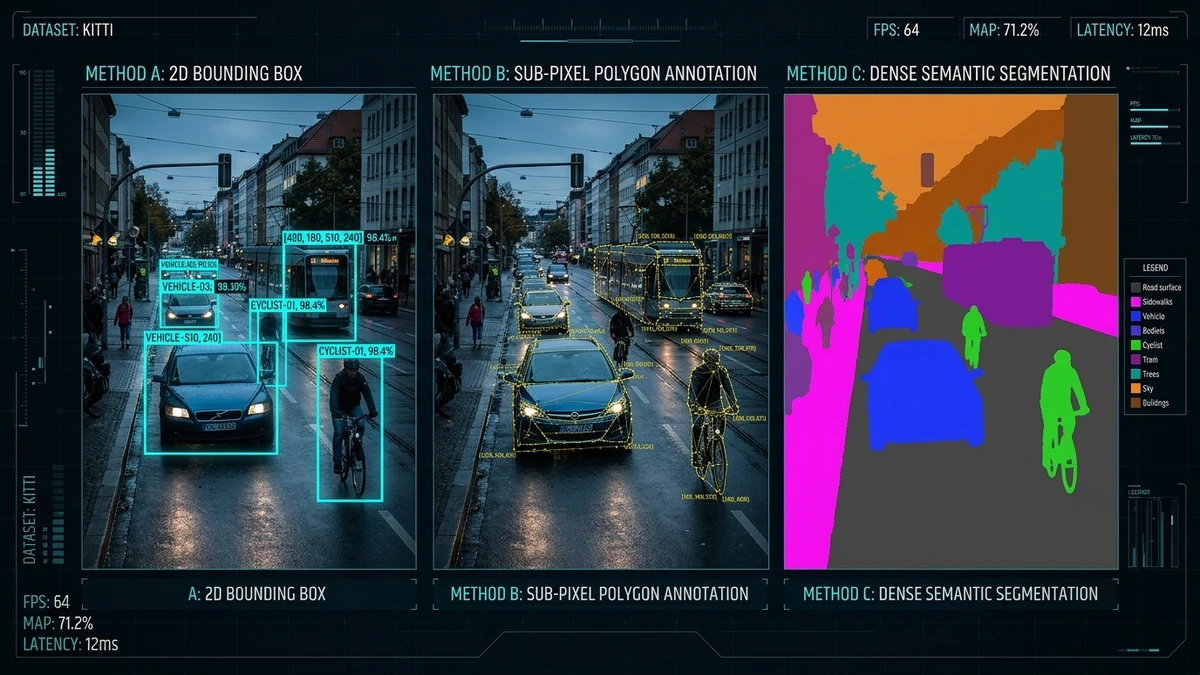
Short answer: Use bounding boxes when your model only needs to find and count objects. Use polygons when the object's real shape matters, for example irregular objects, overlapping items or measuring area. Use semantic segmentation when every pixel matters, such as road surfaces, medical scans or land cover. Boxes are the fastest and cheapest. Polygons cost roughly 2–3× more per object, and full segmentation costs about 30–100× more per image than a few boxes.
Choosing the wrong annotation type is one of the most expensive mistakes in a computer vision project. If you segment data that only needed boxes, you pay many times more for no gain in accuracy. If you box data that needed shapes, your model learns the background along with the object. This guide explains each type, when to use it and what it costs.
Quick comparison
| Bounding box | Polygon | Semantic segmentation | |
|---|---|---|---|
| What it marks | A rectangle around each object | The outline of each object, point by point | A class for every pixel in the image |
| Model type | Object detection (YOLO, Faster R-CNN, DETR) | Instance segmentation (Mask R-CNN, YOLO-seg) | Semantic segmentation (U-Net, DeepLab, SegFormer) |
| Best for | Finding, counting, tracking | Exact shape, overlap, area | Scenes, surfaces, regions |
| Labeling speed | Fastest | Medium | Slowest |
| SevvenLabs price | $0.05–$0.09 per box | $0.12–$1.50 per polygon | $2–$10 per image |
Bounding box annotation: when it is enough
A bounding box is a rectangle drawn around an object. It tells the model where the object is and what it is, but not its exact shape. It is the right choice when:
- You need to detect or count objects: vehicles, people, products on a shelf, animals.
- Objects are roughly rectangular or compact, so little background ends up inside the box.
- You need a lot of data fast and on a limited budget.
- You are tracking objects across video frames.
Limitation: for thin, diagonal or irregular objects (a crane arm, a person lying down, a river), a box includes a lot of background. The model can learn that background as part of the object.
Tip for aerial and drone images: use rotated (oriented) bounding boxes. Ships, vehicles and buildings seen from above are rarely aligned with the image edges, and a rotated box fits them tightly at almost the same cost as a normal box.
Polygon annotation: when shape matters
A polygon traces the outline of an object with a series of points. It captures the real shape, so the model learns the object and not the background around it. Choose polygons when:
- Objects are irregular: leaves, people, animals, rocks, damaged areas.
- Objects overlap and must be separated one by one (instance segmentation).
- You need to measure area or size: crop damage, roof area, wound size, defect size.
- Your model must output a mask, not just a box.
Cost driver: the number of points. A simple shape with up to 10 points costs $0.12 at SevvenLabs, a standard shape with 11–25 points $0.18, and an intricate outline $0.35–$1.50. Agree with your vendor on how precise the edges need to be. "Pixel-perfect" on every object is rarely needed, and it is the fastest way to multiply your budget.
Semantic segmentation: when every pixel matters
Semantic segmentation assigns a class to every pixel in the image: road, sidewalk, car, sky, vegetation. It does not separate individual objects of the same class (all cars are just "car"). Choose it when:
- You care about regions and surfaces more than individual objects: drivable road, water, crops, land use.
- You work with medical images where organ or tissue boundaries matter.
- Your model must understand the whole scene, as in autonomous driving or robot navigation.
Semantic vs instance segmentation: semantic segmentation labels classes ("all of this is car"). Instance segmentation labels each object separately ("car 1, car 2, car 3"), usually with polygons or masks. Panoptic segmentation combines both. If you need to count or track individual objects, you need instance or panoptic segmentation, not semantic segmentation alone.
Cost comparison on the same dataset
Example: 5,000 street images with an average of 6 objects each, at SevvenLabs standard-tier prices.
| Annotation type | Calculation | Estimated cost |
|---|---|---|
| Bounding boxes | 30,000 boxes × $0.07 | $2,100 |
| Polygons | 30,000 polygons × $0.18 | $5,400 |
| Semantic segmentation | 5,000 images × $4 | $20,000 |
The same images can cost ten times more depending on the annotation type. That's why choosing the type comes before choosing a vendor. See the full data annotation pricing guide for every difficulty tier.
How to choose: a 4-question checklist
- What must the model output? A box means bounding boxes. A mask per object means polygons. A class per pixel means segmentation.
- Is the object's shape important for the decision? If no, use boxes. If yes, use polygons.
- Do you need individual objects or regions? Individual objects need boxes or polygons. Regions and surfaces need semantic segmentation.
- Can you start cheaper and upgrade? Often yes. Many teams train a first model on boxes, find where it fails, and add polygons only for those classes.
A mixed approach is common and saves money: boxes for simple classes, polygons for the few classes where shape matters, and segmentation only for the background regions (road, sky, water).
Can AI pre-labeling reduce the cost?
Yes. Tools like Meta's Segment Anything (SAM) and model-assisted labeling can draft polygons and masks automatically, and human annotators then correct them. This works best on clear, high-contrast objects. Crowded scenes, unusual domains (medical, aerial, industrial) and tight accuracy targets still need careful human review, and that review is where quality is won or lost.
Frequently asked questions
What is the difference between bounding box and polygon annotation?
A bounding box is a rectangle around an object and shows only its location. A polygon traces the object's outline point by point and shows its exact shape. Polygons are more accurate for irregular objects but take longer to draw and cost more.
When should I use semantic segmentation instead of bounding boxes?
Use semantic segmentation when your model must understand regions or surfaces pixel by pixel, such as roads, organs, crops or land cover. If you only need to find and count objects, bounding boxes are faster and much cheaper.
What is the difference between semantic and instance segmentation?
Semantic segmentation labels every pixel by class, so all cars are simply "car". Instance segmentation separates each object, so you get car 1, car 2 and car 3. Use instance segmentation when you need to count or track individual objects.
Which annotation type is best for drone and aerial images?
Rotated (oriented) bounding boxes work best for vehicles, ships and buildings seen from above. Polygons suit irregular shapes like roofs or damaged areas, and semantic segmentation suits land cover and crop fields.
How much more does polygon annotation cost than bounding boxes?
Usually about 2–3 times more per object. At SevvenLabs a standard bounding box costs $0.07 and a standard polygon $0.18.
Not sure which annotation type your project needs? Book a 30-minute scoping call. We'll recommend the cheapest type that meets your accuracy target, and label 5–10 of your images free so you can compare. Explore our data labeling services or drone and aerial annotation.