
In-House vs Outsourced Data Labeling: The Real Cost Math (2026)
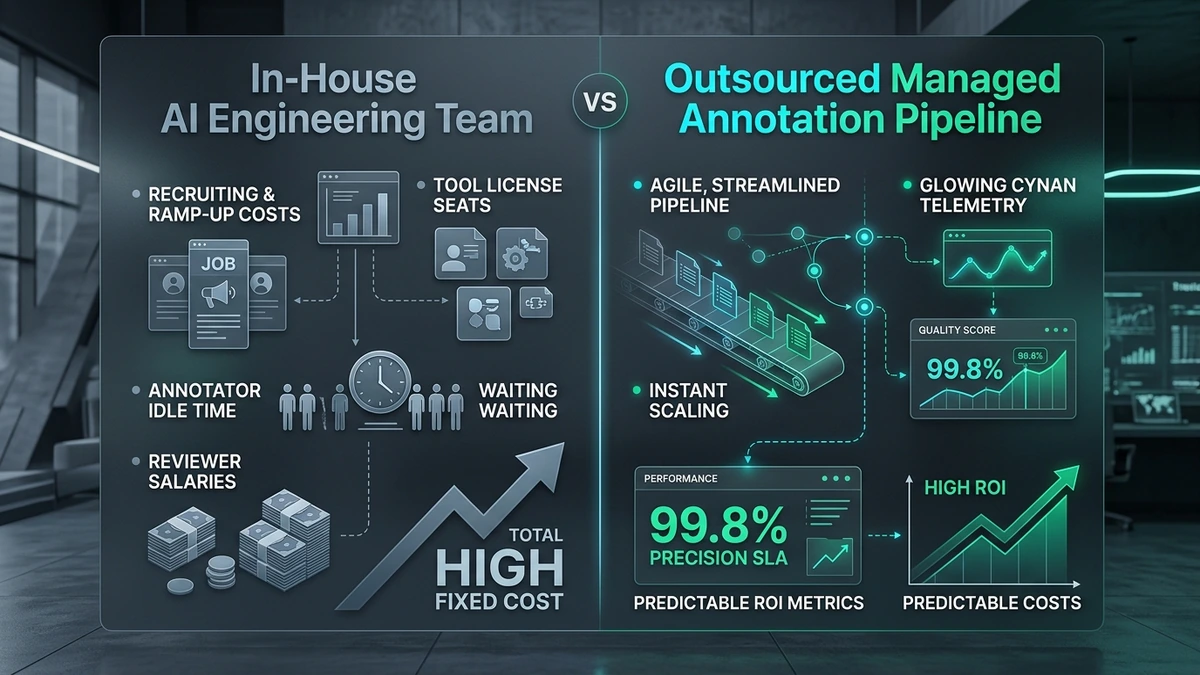
Short answer: Outsourcing data labeling is usually cheaper and faster when you need more than a few thousand labeled images, have a deadline, or need the work to scale up and down. An in-house team makes sense when your data cannot leave your building, your guidelines change every day, or labeling is a permanent, full-time need. Most growing AI teams end up hybrid: a small in-house expert team writes guidelines and checks quality, and an outsourced team does the volume.
The mistake most teams make is comparing an hourly wage with a per-label price. The real cost of in-house labeling includes hiring, training, tools, management, QA and idle time between projects. This guide shows the full math.
The real cost of an in-house labeling team
An in-house team costs much more than annotator salaries. A realistic budget includes:
- Salaries and benefits for annotators, plus employer taxes and benefits on top of base pay.
- Hiring and training. Recruiting, onboarding and weeks of ramp-up before annotators reach full speed and accuracy.
- QA reviewers. Someone has to check the labels, usually 1 reviewer for every 4–6 annotators.
- A project manager or team lead to write guidelines, answer edge cases and track output.
- Tools and infrastructure. Labeling platform seats, storage, compute and IT security.
- ML engineer time. Engineers often end up reviewing labels or labeling themselves, which is the most expensive labor in the company.
- Idle time. Between datasets, a full-time team still gets paid even when there is nothing to label.
Cost math: an example
Example project: 100,000 bounding boxes (about 12,500 images with 8 objects each) at a standard difficulty level. The in-house figures below are illustrative assumptions. Replace them with your own salaries and speeds.
| Cost item | In-house (example) | Outsourced to SevvenLabs |
|---|---|---|
| Labeling speed | ~150 boxes per hour per annotator | Included |
| Annotator hours needed | ~670 hours | Included |
| Annotator cost (at $25/hour fully loaded) | ~$16,700 | Included |
| QA review (~20% extra time) | ~$3,300 | Included (1 human QA pass) |
| Hiring, training and ramp-up | $2,000–$5,000+ | $0 |
| Tools and team lead time | $1,500–$4,000+ | $0 |
| Total | ~$23,500–$29,000 | 100,000 × $0.07 = $7,000, minus 10% volume discount = $6,300 |
Even with conservative assumptions, outsourcing costs a fraction of the in-house total for a one-off dataset. The gap closes only when you have steady, full-time labeling work all year and keep the team busy every day. See our data annotation pricing guide for all tiers.
When in-house labeling is the right choice
- Data cannot leave your environment for legal or contract reasons, and a vendor cannot work inside your systems.
- Guidelines change daily because you are still researching what the model needs.
- Deep expertise is required that only your own staff has, such as rare medical sub-specialties.
- Labeling is permanent and constant, so a team stays fully busy year-round.
When outsourcing is the right choice
- You need a dataset by a deadline and can't wait to hire and train people.
- Volume goes up and down: big batches, then quiet weeks.
- Your ML engineers are spending their time labeling instead of building models.
- You want predictable cost per label instead of fixed salaries.
- You need QA built in without building a review process yourself.
The hybrid model: what most teams end up doing
The most common setup in growing AI teams: one or two in-house people own the guidelines, edge cases and final acceptance, and an outsourced team handles the volume and first-pass QA. You keep control of quality and only pay for labeling when you need it.
To make hybrid work:
- Write a short guideline with visual examples of edge cases (what to label and what to skip).
- Agree on a measurable accuracy target before the work starts.
- Start with a small pilot, review it together and fix the guideline.
- Check a random sample of every batch in-house before accepting it.
Risks of outsourcing and how to avoid them
| Risk | How to avoid it |
|---|---|
| Low quality labels | Run a pilot first, and agree an accuracy target with free rework if a batch misses it. |
| Data security | Sign an NDA before sharing data. Limit access to named annotators, or have the vendor work inside your own tool. |
| Hidden costs | Ask for per-label prices that include QA, and check for setup fees or minimum orders. |
| Anonymous crowd workers | Ask who actually labels your data. A dedicated team is more consistent than a rotating crowd. |
| Slow communication | Agree on one project contact and a shared chat channel from day one. |
How SevvenLabs works with in-house teams
- Dedicated remote team. The same trained annotators stay on your project. No anonymous crowdsourcing.
- Accuracy agreed up front. We set the target together in the scoping call, and any batch below it is reworked free.
- Fits your workflow. We can label in your own tool or ours, and export in the format your model needs (COCO, YOLO, Pascal VOC, JSON or CSV).
- Free pilot on 5–10 of your images (or 2–5 short videos) before you commit.
Frequently asked questions
Is it cheaper to outsource data labeling or do it in-house?
For most projects, outsourcing is cheaper. In-house costs include salaries, training, QA reviewers, tools, management and idle time, which often makes the true cost per label several times higher than a vendor's price. In-house only becomes competitive with constant, year-round labeling work.
When should a company outsource data annotation?
Outsource when you have a deadline, volume that rises and falls, or ML engineers who are spending time labeling. Keep labeling in-house when data cannot leave your systems or guidelines change every day.
What are the risks of outsourcing data labeling?
The main risks are low quality, data security and hidden costs. You can reduce them with a pilot project, an agreed accuracy target with free rework, an NDA, and per-label prices that include QA.
Can I combine in-house and outsourced labeling?
Yes, and many teams do. Your in-house experts own the guidelines and final quality checks, and the outsourced team handles the volume. This hybrid model keeps quality under your control and cost flexible.
Want to compare your in-house cost with outsourcing? Book a 30-minute call and we'll estimate your project, or send us 5–10 sample images for a free pilot. See our data labeling services.