
How to Choose a Data Labeling Vendor: 12-Point QA, Security & Pricing Checklist
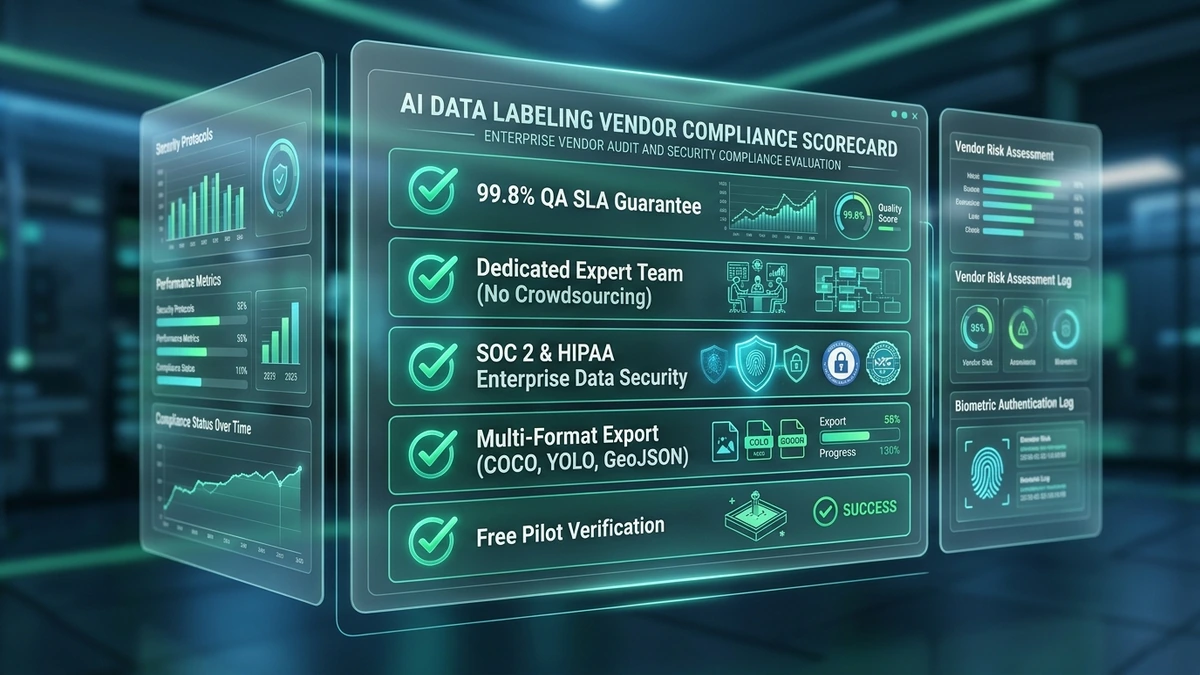
Short answer: To choose a data labeling vendor, run a small paid or free pilot on your own data, then score each vendor on 12 points: accuracy target and rework terms, QA process, who actually does the work, data security, domain experience, tool and format support, turnaround, scalability, communication, pricing transparency, contract terms and references. Price matters, but rework from bad labels usually costs more than the difference between two vendors.
Most vendor websites look the same: "high quality", "secure", "scalable". This checklist turns those claims into questions you can verify before you sign.
The 12-point data labeling vendor checklist
Quality
- Accuracy target and rework terms. Ask: "What accuracy will you commit to for my data, how is it measured, and what happens if a batch misses it?" A good answer names a metric (such as label accuracy or IoU), a target, and free rework.
- QA process. Ask how many people check each label. Is review done on 100% of labels or a sample? Is there a final check before delivery?
- Edge-case handling. Ask how annotators handle unclear cases. Good vendors keep a shared log of edge cases and update the guideline with you.
People and security
- Who does the work. Ask if your data goes to a dedicated, trained team or to an anonymous crowd platform. Dedicated teams give more consistent labels.
- Data security. Ask about NDAs, who can access your data, where it is stored, and whether the vendor can work inside your own tool or cloud. If you need formal certifications (SOC 2, ISO 27001, HIPAA), ask for proof. Don't accept a logo on a website.
- Domain experience. Ask for examples of similar data: medical, aerial, autonomous driving, retail. Domain knowledge matters most on hard edge cases.
Delivery
- Tools and formats. Can they work in your labeling tool, and deliver in your format (COCO, YOLO, Pascal VOC, JSON)?
- Turnaround time. Ask for a delivery schedule for your volume, and whether rush delivery is possible.
- Scalability. Can they double the team for a big batch, and scale back down without penalty?
- Communication. Will you have one named project contact, a shared chat channel and regular progress reports?
Commercial
- Pricing transparency. Ask for per-label prices by difficulty, what's included (QA, formats, setup) and any minimum order. Be careful with quotes that only say "contact sales" until late in the process.
- Contract terms and references. Check data ownership (you should own all labels), deletion of your data after the project, notice periods, and talk to at least one past client if possible.
Vendor scorecard template
Score each vendor from 1 (poor) to 5 (excellent) after the pilot. Weight the points that matter most for your project.
| Criteria | Weight | Vendor A | Vendor B | Vendor C |
|---|---|---|---|---|
| Pilot accuracy on your data | ×3 | |||
| QA process and rework terms | ×2 | |||
| Security and data handling | ×2 | |||
| Dedicated team (not crowd) | ×1 | |||
| Domain experience | ×1 | |||
| Price per label (incl. QA) | ×2 | |||
| Turnaround and scalability | ×1 | |||
| Communication | ×1 |
How to run a fair vendor pilot
- Pick 5–20 representative images, including a few typical hard cases. Send the same set to every vendor.
- Write a one-page guideline with your classes and 3–5 visual edge-case examples.
- Label a small "gold" set yourself so you can measure each vendor's accuracy objectively.
- Compare results on accuracy, missed objects, edge precision, and how well each vendor asked questions.
- Agree the accuracy target and price tier with your chosen vendor before scaling up.
Red flags when hiring a data labeling company
- No pilot, or a pilot only on their own sample data.
- No clear answer on who labels your data.
- Very low prices with no QA included.
- Certification badges they cannot show proof for.
- No written rework or accuracy terms.
- Slow or vague answers during the sales process. It rarely improves after you sign.
How SevvenLabs answers this checklist
- Accuracy: we agree the target with you in the scoping call, and any batch below it is reworked free.
- QA: every label gets a human QA review. Double review of 100% of labels is available.
- People: a dedicated, long-term remote team. No anonymous crowdsourcing.
- Security: NDA before you share data. Access limited to your project team, and we can work inside your own tool.
- Pricing: public per-label prices by difficulty. See our pricing guide.
- Pilot: free on 5–10 of your images (or 2–5 short videos).
Frequently asked questions
How do I choose a data annotation company?
Run a pilot on your own data with 2–3 vendors, then score them on accuracy, QA process, security, who does the work, price per label including QA, turnaround and communication. Choose the vendor with the best pilot accuracy at an acceptable price, not simply the cheapest.
How do data labeling companies ensure quality?
Good vendors use trained annotators, written guidelines with edge-case examples, one or more human review passes, and an agreed accuracy target with free rework when a batch misses it.
What should be included in a data annotation pilot?
A small set of your real images including some hard cases, a one-page guideline, and a gold set labeled by your own team so you can measure accuracy objectively.
Is offshore data annotation safe for sensitive data?
It can be, if the vendor signs an NDA, limits access to named team members, and ideally works inside your own systems so data never leaves them. For regulated data, ask for proof of any certification the vendor claims.
Evaluating vendors right now? Add SevvenLabs to your shortlist: send 5–10 sample images for a free pilot, or book a 30-minute scoping call. Learn more about our data labeling services.